Varsha Ritucharya
The Monsoon Regimen — How Ayurveda Prepares the Body for the Rainy Season
The monsoon arrives with a particular kind of drama — cooler air, flooded streets, the first smell of wet earth. For most of us, it is a sensory experience. For Ayurveda, it is a clinical event. The rainy season, or Varsha Ritu, marks one of the most physiologically vulnerable windows of the year: digestive fire weakens, Vata aggravates, immunity dips, and the body becomes susceptible to a range of disorders it sailed past all summer.
The solution is not to wait and treat. The solution is Ritucharya — the seasonal regimen. Described in detail across Charaka Samhita, Ashtanga Hridaya, and Sushruta Samhita, Varsha Ritucharya is a precise protocol of diet, lifestyle, purification, and self-care calibrated to the specific physiological changes of the monsoon. Three thousand years old. Increasingly validated by modern science. Still as relevant as the first day of rain.
1. What Is Varsha Ritu?
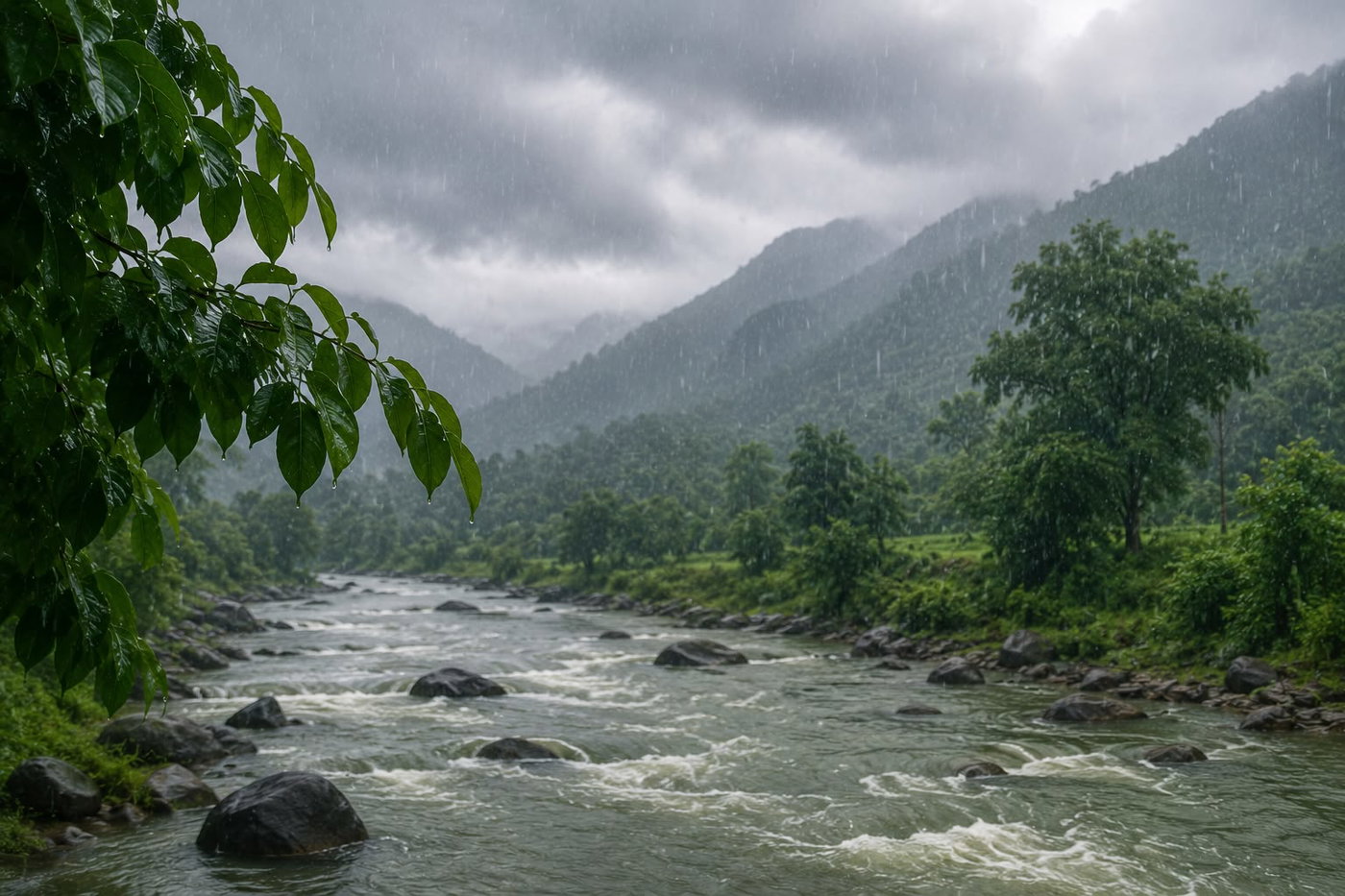
Varsha Ritu spans the months of Shravana and Bhadrapada — roughly mid-July to mid-September — in the Indian calendar. It falls within Dakshinayana, the southern solstice, which classical texts call Visarga Kala (the season of nourishment), a period where the sun moves southward and the moon gains relative dominance. The earth becomes moist, rivers swell, the atmosphere turns acidic, and the sky stays overcast.
मासैर्द्विसंख्यैर्माघाद्यैः क्रमात् षडृतवः स्मृताः... वर्षाशरद्धिमाः "A season (Ritu) is comprised of two months. The six seasons are: Shishira, Vasanta, Greeshma, Varsha, Sharat, and Hemanta. Varsha Ritu spans Shravana and Bhadrapada (mid-July to mid-September)." — Ashtanga Hridayam, Sutrasthana 3/1 (Ritucharya Adhyaya) |
Charaka names the six seasons similarly (Sutrasthana, Ch. 6), while Sushruta's classification introduces the additional category of Pravrit — a pre-monsoon early-rain season — reflecting the greater rainfall patterns of South India. Dalhana, the 12th-century commentator on Sushruta, clarifies this regional difference: in southern Gangetic plains where rainfall is heavier, Pravrit and Varsha are described separately, whereas in the north, Charaka subsumes both under Varsha.
2. What Happens Inside the Body During Varsha
Ayurveda does not view the body as isolated from its environment. The physiological changes of any season mirror the changes in the external world. During Varsha, three specific internal events define the clinical picture:
Vata Aggravation (Vata Prakopa)
All summer long, Vata dosha underwent accumulation (Sanchaya) due to the dry, light, and depleting nature of the hot season. The onset of rains — with their irregular wind, cold, and dampness — triggers the aggravation (Prakopa) of this accumulated Vata. This explains the classic monsoon complaints: joint pain, erratic digestion, flatulence, constipation, anxiety, and body ache.
ग्रीष्मे वायुः प्रकोपाय सञ्चितः वर्षासु प्रकुप्यति "Vata, accumulated during summer (Greeshma), becomes aggravated during the rainy season (Varsha)." — Sushruta Samhita, Sutrasthana Ch. 6 (Ritucharya Adhyaya) |
Weakening of Agni (Mandagni)
Agni — the digestive and metabolic fire — reaches its low point during Varsha. The cold, damp, cloudy environment and the atmosphere's increased acidity (Amla guna of Varsha) douse digestive capacity. Mandagni leads to Ama formation (undigested metabolic residue), the root cause of most monsoon illnesses from gastroenteritis to fevers.
वर्षासु... मन्दोऽग्निर्भवति, दुष्टाश्च मलाः "During the rainy season, Agni (digestive fire) becomes weak and the Doshas become vitiated." — Charaka Samhita, Sutrasthana Ch. 6 (Tasyashiteeya Adhyaya) |
Pitta Accumulation (Pitta Sanchaya)
While Vata aggravates and Agni weakens, Pitta quietly accumulates throughout the monsoon — primed to explode in the following season, Sharad (autumn). The acidic quality of rainwater and fermented earth both contribute to Pitta's build-up. This is why monsoon-acquired Pitta manifests as skin diseases, fevers, acid peptic disorders, and inflammatory conditions in autumn.
वर्षाशीतोचिताङ्गानां सहसैवार्करश्मिभिः तप्तानां सञ्चितं वृष्टौ पित्तं शरदि कुप्यति "The person becomes accustomed to the cold of the rainy season. When suddenly exposed to the warm rays of the sun (in Sharad), the Pitta accumulated during Varsha becomes greatly aggravated." — Ashtanga Hridayam, Sutrasthana Ch. 3 (Ritucharya Adhyaya) | Also: Charaka Samhita, Sutrasthana Ch. 6 |
Modern parallel: A 2024 cross-sectional observational study of 200 healthy individuals during Varsha Ritu (July–September) confirmed Ayurvedic predictions — predominance of Mandagni, intermittent immune symptoms, and reduced Bala (physical strength) were documented, consistent with Doshic imbalance. The study used WHO-validated immune status questionnaires alongside Ayurvedic assessment parameters.Ref: Seasonal Variation in Immunity During Varsha Ritu: A Cross-Sectional Study. Journal of Ayurveda and Integrated Medical Sciences (JAIMS), 2026. |
3. Ahara — The Monsoon Diet
Dietary guidelines in Varsha Ritucharya are calibrated to one central reality: Agni is weak. Everything follows from that. The food must be warm, light, easily digestible, and cooked fresh. The instinct to eat raw salads, drink cold beverages, or fast intermittently — all popular modern practices — is directly contraindicated during the monsoon in classical Ayurveda.
What to Eat
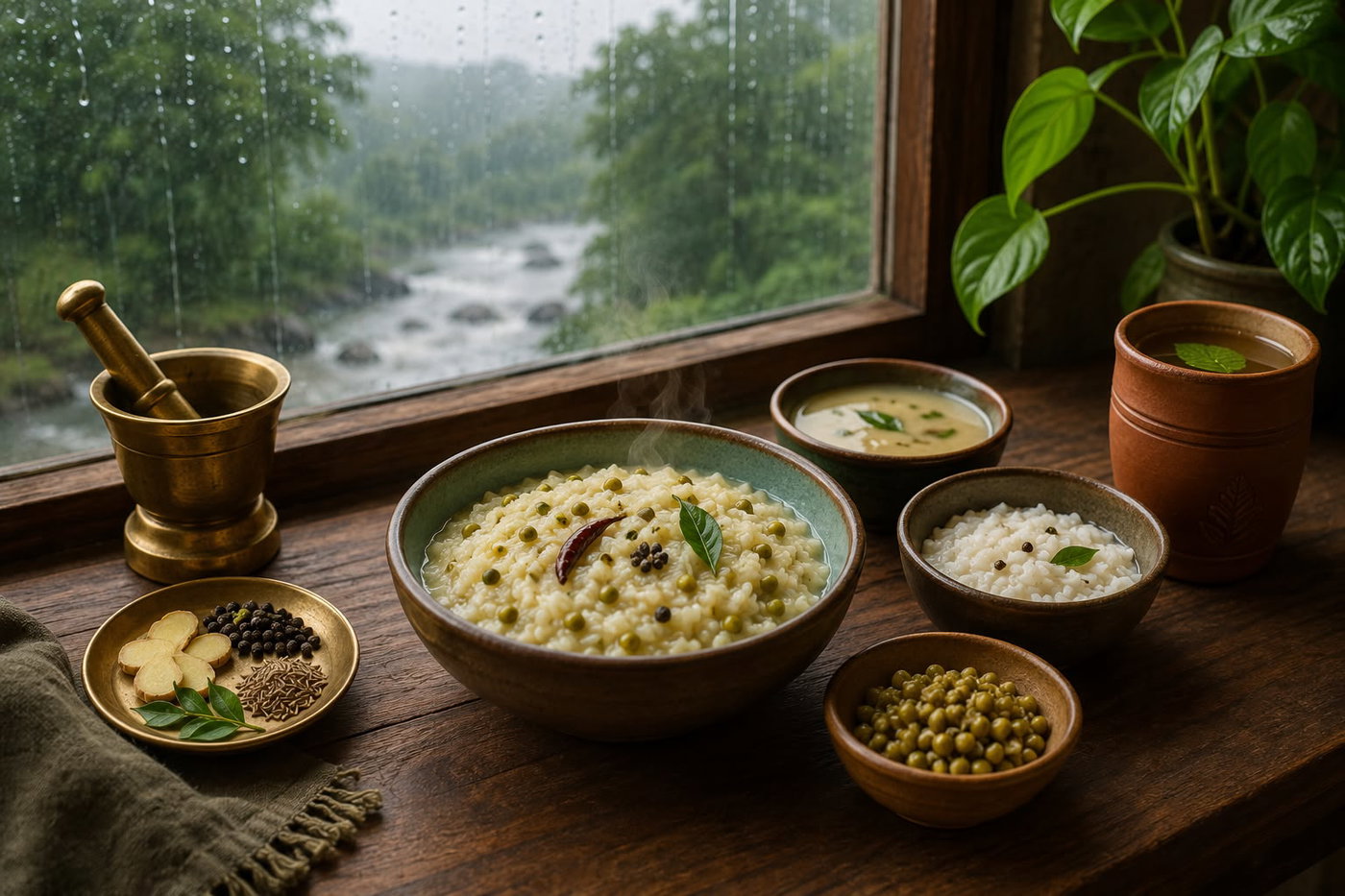
जाङ्गलं मांसमम्लं च यवगोधूमषष्टिकम् | पुराणं शालिमुद्गांश्च वर्षास्वशनमुच्यते || "During Varsha Ritu, one should consume meat of arid-land animals (Jangala Mamsa), sour foods, barley (Yava), wheat (Godhuma), Shashtika rice, old Shali rice, and green gram (Mudga)." — Charaka Samhita, Sutrasthana Ch. 6 |
दिवास्वप्नवर्जितः स्यात् पानं जलस्य चाग्निसंस्कृतस्य "During Varsha Ritu, one should consume easily digestible food and drink only fire-processed (boiled) water. Avoid sleeping during the daytime." — Ashtanga Hridayam, Sutrasthana Ch. 3 (Ritucharya Adhyaya) |
Across all three classical texts, the dietary principles of Varsha Ritucharya converge on the following:
Old grains — aged rice (Shali), barley, wheat — are preferred over freshly harvested, because old grains are lighter and easier to digest
Green gram (Mudga / Moong dal) — the safest legume in Ayurveda; light, Vata-pacifying, easy on Agni
Sour and salty tastes (Amla and Lavana rasa) — the prescribed dominant tastes of Varsha, as they pacify aggravated Vata
Ghee (Cow's ghee) — anupana and cooking medium; Vata-pacifying, oleating, and Agni-kindling
Rock salt (Saindhava Lavana) — preferred over sea salt; lighter and more digestible; Vata-pacifying
Warm soups, light gruels (Yusha, Peya, Vilepi) — especially during illness or for daily maintenance
Ginger and rock salt before meals — classical digestive aperitif; recorded in multiple texts
Honey — as food additive or in drinks; Charaka specifically recommends honey-processed foods in Varsha for its gut-beneficial properties
What to Avoid
नदीजलोदमन्थाहःस्वप्नायासातपांस्त्यजेत् "Avoid river water, Udamantha (a heavy flour-ghee drink), daytime sleeping, excessive exertion, and sun exposure." — Ashtanga Hridayam, Sutrasthana Ch. 3 |
River water and tank water — contaminated and acidic during monsoon; use only boiled or purified water
Heavy, oily, and raw foods — tax the already weakened Agni
Cold beverages and refrigerated food — suppress Agni further
Curd (Dadhi) — contraindicated specifically in Varsha; increases Kapha and Ama
Fermented foods — Varsha's already heightened environmental acidity makes additional fermented inputs destabilising
Excessive fasting — Charaka explicitly warns against fasting during Varsha as it further diminishes Agni and increases Vata
The gut microbiome connection: A 2021 review in the Journal of Ethnic Foods (Springer Nature) mapped Varsha Ritucharya dietary guidelines directly against modern gut microbiome science. It found that the prescribed foods — ginger, honey, old rice, barley, green gram, and foods rich in fructo-oligosaccharides like garlic and onion — selectively promote Bifidobacterium spp. and Bacteroides intestinalis while suppressing pathogenic species like E. coli and Klebsiella pneumoniae. The Ayurvedic rationale of protecting Agni during monsoon aligns precisely with modern understanding of seasonal gut dysbiosis.Ref: Deepthi R. et al. Adopting seasonal regimen (Ritucharya) to modulate seasonal variation in gut microbiome. Journal of Ethnic Foods, 8:8, 2021. DOI: 10.1186/s42779-021-00078-4 |
4. Vihara — The Monsoon Lifestyle
If Ahara (diet) addresses what you put into the body, Vihara (regimen) addresses how you move through the world. Varsha Vihara is about maintaining warmth, protection, and calm — counteracting the damp, erratic, and aggravating nature of the season.
What to Practise
अभ्यङ्गोत्सादने धूपं गन्धमाल्यानुलेपनम् | निवाताके गृहे वासं वर्षास्विति निदर्शितम् || "During Varsha, one should practise Abhyanga (oil massage), Udgharsana (dry powder massage), Dhupa (fumigation), use of fragrant garlands and ointments, and reside in draught-free, well-ventilated homes." — Ashtanga Hridayam, Sutrasthana Ch. 3 (Ritucharya Adhyaya) |

Abhyanga (oil massage) — daily application of warm Sesame oil or Dhanwantharam Tailam; pacifies Vata, improves circulation, and strengthens the skin barrier
Warm baths with herbal powders — removes humidity from the skin; balances Kapha
Light indoor exercise — Charaka recommends Vyayama (exercise) that is half one's capacity; excessive physical exertion is specifically forbidden in Varsha
Fumigation (Dhupa) — burning medicinal herbs indoors purifies the humid environment; classical texts recommend Neem, Guggulu, and Vacha for fumigation
Fragrant application — Chandan (sandalwood) or rose-based pastes or oils; cooling and antimicrobial
Wear dry, clean clothes — avoid damp garments; change promptly when wet
What to Avoid
Daytime sleeping (Divaswapna) — explicitly forbidden in Varsha; increases Kapha and further weakens Agni
Exposure to rain and cold wind — especially Purva Vayu (eastern wind) described in Ashtanga Hridaya as particularly aggravating
River bathing and wading through floodwater — classical texts prohibit contact with contaminated water
Excessive physical or sexual exertion — depletes the already lowered Ojas (vital immunity)
Excessive sun exposure, especially in the afternoon
Sushruta's Sutrasthana Ch. 6 adds the recommendation that aggravated Vata should be specifically treated and eliminated during Varsha — the season most favourable for Vata management — before it produces disease. This is the basis of the Panchakarma timing recommendation: Basti (medicated enema), the premier Vata-pacifying procedure, is classically indicated during the monsoon.
5. Shodhana — The Monsoon Purification Window
One of the most clinically important aspects of Varsha Ritucharya — and yet the least known publicly — is its designation as the optimal season for specific Panchakarma (bio-purification) therapies.
वातः कोपाय सञ्चितः... दोषांश्च हरणं प्रोक्तं ऋतौ स्वे स्वे विशेषतः "The accumulated Dosha should be eliminated in its respective season of aggravation — specifically, before diseases are produced. For Vata: Varsha Ritu. For Pitta: Sharad. For Kapha: Vasanta." — Sushruta Samhita, Sutrasthana Ch. 6 (Ritucharya Adhyaya) |
Basti (medicated enema) — the supreme Vata-pacifying Panchakarma; classically prescribed for Varsha Ritu. Anuvasana Basti (oil enema) and Niruha Basti (decoction enema) are the standard protocols.
Abhyanga + Sweda (oil massage + steam therapy) — as a preparatory and therapeutic Snehana-Svedana protocol for Vata management
The classical rationale is precise: just as a farmer ploughs before the rains arrive rather than after flooding, the wise physician eliminates accumulated Doshas before disease has manifested. The monsoon — with its characteristic Vata aggravation — is the physiologically optimal window for Vata-targeted purification.
6. Jala — The Question of Water
Water during Varsha Ritu receives its own special attention in all three classical texts — a level of specificity that reflects how intimately ancient physicians understood the contamination dynamics of seasonal water sources.
वर्षासु तु सरिज्जलमम्लं गुर्वभिष्यन्दि च | तस्मात् तत् परिवर्जयेत् || "River water during Varsha is sour (acidic), heavy, and causes increased secretion (Abhishyandi). Therefore it should be avoided." — Charaka Samhita, Sutrasthana Ch. 6 |
All three texts prescribe that drinking water during Varsha must be fire-processed — boiled, cooled, and if possible stored in clean copper vessels or infused with medicinal herbs such as Ushira (Vetiver), Dry Ginger, or Patha. The preference for stored rainwater (Gangambha — collected from open skies before touching the ground) is explicitly noted in Charaka and Ashtanga Hridaya.
The modern relevance is self-evident: monsoon season sees the highest incidence of waterborne diseases — cholera, typhoid, viral hepatitis, leptospirosis — in tropical countries. The classical injunction against river water and prescription for boiled water is not superstition; it is evidence-based preventive medicine from the first millennium BCE.
7. What Modern Science Says
The specific physiological predictions of Varsha Ritucharya — weakened immunity, depressed digestive function, Vata aggravation — are increasingly supported by modern research on seasonality, chronobiology, and the gut microbiome.
Seasonal Immunity and Bala
A 2024 study found that maximum Bala (physical strength) occurs in Hemanta (winter) and minimum in Varsha — precisely as classical texts predicted. The seasonal reduction in Bala correlates with immune parameter fluctuations, supporting Ayurveda's clinical framing of Varsha as a high-risk immunological window.
Ref: Ritucharya — Charaka Samhita Research Foundation, PMC3361919 (2012). Also: JAIMS, Seasonal Variation in Immunity During Varsha Ritu, 2026.
Seasonal Variation in Gut Microbiome
Multiple peer-reviewed studies now confirm that the gut microbiome itself changes with seasons — mirroring Ayurveda's concept of seasonal Agni and Dosha fluctuations. A 2021 Springer Nature review demonstrated that Ritucharya-aligned dietary recommendations for Varsha (ginger, honey, old grains, green gram) directly support Bifidobacterium and Bacteroides growth while suppressing pathogenic species — the same species that proliferate in contaminated monsoon water and food.
Ref: Deepthi R. et al. Adopting seasonal regimen (Ritucharya) to modulate seasonal variation in gut microbiome. Journal of Ethnic Foods, 8:8, 2021. DOI: 10.1186/s42779-021-00078-4
Circadian Rhythms, Seasonality, and Health
Modern chronobiology has firmly established that seasonal change alters circadian rhythm regulation — affecting cortisol patterns, metabolic rate, sleep architecture, and immune function. A 2025 review in Frontiers in Endocrinology documented the close interplay between circadian clocks, gut microbiota, and systemic physiology — a molecular framework that maps directly onto the Ayurvedic concept of seasonal Dosha cycles.
Ref: Bautista J. et al. Chronobiome medicine: circadian regulation of host-microbiota crosstalk. Frontiers in Endocrinology, 2025. DOI: 10.3389/fendo.2025.1691172. PMC12623188.
Seasonal Regimen and Lifestyle Disorders
A 2025 review published in JAIMS (Journal of Ayurveda and Integrated Medical Sciences) confirmed that following Ritucharya — including Varsha-specific protocols — demonstrably reduces seasonal fluctuations in gut microbial diversity, immune markers, and metabolic parameters. The review concluded that aligning with seasonal natural cycles through Ritucharya may reduce the risk of lifestyle diseases — bridging classical preventive medicine with contemporary epidemiology.
Ref: Ayushi K. et al. Ritucharya in Lifestyle Disorder Management. JAIMS, Vol. 10, Issue 9, Sept 2025.
The Bottom Line
Varsha Ritucharya is not a collection of old beliefs preserved by tradition. It is a clinical framework built by careful observation — observation of what the monsoon does to the human body and what the body needs in return. Weak digestion needs warm, light food. Aggravated Vata needs oil and warmth. A contaminated water supply needs boiling. A vulnerable immune system needs protection from exertion and cold.
Three thousand years of refinement by the brightest medical minds of the ancient world arrived at the same conclusions that modern chronobiology, gut microbiome science, and infectious disease medicine are now quantifying. The prescriptions align. The science is catching up. The monsoon is not waiting.
References
1. Charaka Samhita — Sutrasthana, Tasyashiteeya Adhyaya, Ch. 6. Acharya JT, editor. Chaukhambha Surbharati Prakashan, Varanasi.
2. Ashtanga Hridayam (Vagbhata) — Sutrasthana, Ritucharya Adhyaya, Ch. 3. Paradakara HS, editor. With Sarvanga Sundara commentary by Arundatta. Chaukhambha Surbharati Prakashana, Varanasi; 2011.
3. Sushruta Samhita — Sutrasthana, Ritucharya Adhyaya, Ch. 6. As expounded by Dhanvantari; Dalhana commentary. Chaukhambha Orientalia, Varanasi.
4. Ashtanga Sangraha — Sutrasthana, Ritucharya chapter. Shashilekha commentary.
5. Bhavaprakasha Nighantu — Mishra BS, Vaishya R, editors. 16th century CE, Haritakyadi Varga.
6. Deepthi R., Vandana Rani M., Delvin T. Robin, Anushree Dilip. (2021). Adopting seasonal regimen (Ritucharya) to modulate the seasonal variation in gut microbiome. Journal of Ethnic Foods, 8:8. DOI: 10.1186/s42779-021-00078-4. Springer Nature.
7. Seasonal Variation in Immunity During Varsha Ritu: A Cross-Sectional Study. Journal of Ayurveda and Integrated Medical Sciences (JAIMS), 2026. Vol. 9. (200 participants, WHO-validated ISQ tool, July–September 2024).
8. Ayushi K. et al. Ritucharya in Lifestyle Disorder Management. JAIMS, Vol. 10, Issue 9, September 2025. DOI: 10.55691/jaims.
9. Sharma N. et al. Ritucharya: Answer to Lifestyle Disorders. Ancient Science of Life / PMC. PMC3361919, 2012.
10. Bautista J., López-Cortés A. (2025). Chronobiome medicine: circadian regulation of host-microbiota crosstalk in systemic physiology. Frontiers in Endocrinology. DOI: 10.3389/fendo.2025.1691172. PMC12623188.
11. Thaiss CA. et al. (2016). Transkingdom control of microbiota diurnal oscillations promotes metabolic homeostasis. Cell, 159(3):514–529. (Circadian-microbiome axis).
12. Mohd Mian MF. et al. (2020). Circadian Host-Microbiome Interactions in Immunity. Frontiers in Immunology. PMC7456996.
13. Fazlani Nature's Nest Ayurveda. Ritucharya: How Ayurvedic Seasonal Cleansing Prepares Your Body for Lasting Health. 2025. (Review article).
This article is provided by MEDMAP — a premier institution dedicated to Ayurvedic education that combines classical wisdom with contemporary clinical training. MEDMAP offers a wide range of Ayurvedic courses with hands-on clinical exposure, designed for BAMS graduates and Ayurveda practitioners at every stage of their career. 🌐 For courses, updates, and career resources, follow MEDMAP on all platforms. 📱 Instagram https://www.instagram.com/ayurvedamap 🌐 Website https://medmapmedical.com |
|---|