OVERVIEW
Cardiovascular diseases remain the leading cause of mortality worldwide, and India bears one of the highest burdens of heart disease in Asia. Cardiovascular diseases (CVDs) have overtaken infectious diseases to become the single largest cause of mortality in the country — accounting for more than a quarter of all deaths nationally. Unlike in Western populations, heart disease in India strikes early, progresses fast, and kills at scale during the most productive years of life.
>25% of all deaths in India attributed to CVD | 52% of CVD deaths in India occur before age 70 | 272/lakh age-standardised CVD death rate — above the global average of 235 | 11% pooled prevalence of CVD among Indian adults (2025 meta-analysis) |
In comparison with European populations, CVD affects Indians at least a decade earlier. Over half of cardiac deaths in India occur in people under 70 — compared to just 23% in Western nations. Hypertension, the primary driver of cardiac events, affects an estimated 30% of adult Indians, with the number of hypertensive individuals projected to grow to over 213 million. The burden is no longer confined to the elderly — young adults in their 30s and 40s are increasingly presenting with acute cardiac events, driven by stress, dietary shifts, sedentary lifestyles, and metabolic syndrome.
Cardiovascular diseases continue to be the overwhelming cause of deaths among both men and women across urban and rural India, with urban areas showing higher prevalence — a pattern confirmed in a June 2025 national report. The epidemiological transition has been rapid, compressed into just two to three decades — leaving the healthcare system scrambling to keep pace.
This is not a distant public health statistic. For every BAMS practitioner working in an outpatient clinic, wellness centre, or independent practice today, cardiac conditions — hypertension, dyslipidaemia, IHD, and metabolic syndrome — constitute a significant and growing proportion of daily consultations. |
CORE PRINCIPLES OF AYURVEDA CARDIOLOGY
Ayurveda views cardiology through a holistic, systemic lens rather than focusing solely on the structural mechanics of the heart. In Ayurvedic classical texts, the heart is known as Hridaya, and it holds a uniquely elevated status: it is considered one of the three principal vital organs (Trimarma) and the seat of consciousness (Chetana), life energy (Prana), and immunity (Ojas).
Traditional Ayurvedic cardiology classifies heart diseases under the umbrella of Hridroga. Unlike contemporary cardiology, which primarily targets localised pathology (like a blocked artery), Ayurveda treats the heart as the root of the circulatory system (Rasa-Rakta Vaha Srotas).
THE SCOPE OF AYURVEDA IN CARDIAC CARE
Despite the enormous burden, modern cardiology faces critical limitations. Management of hypertension and IHD remains largely palliative — centred on lifelong medications with significant side-effect profiles, interventional procedures, and high financial costs. The system is chronically under-resourced relative to need, particularly at the primary and secondary care levels where most patients first present.
Ayurveda offers a distinct and clinically valuable framework for addressing cardiovascular disease. Far from being peripheral, Ayurvedic cardiology has a sophisticated classical foundation in the understanding of Hridroga, with clearly articulated Nidana (causation), Samprapti (pathophysiology), and Chikitsa (management) that maps remarkably well onto modern understanding of atherosclerosis, hypertension, and heart failure.
Recent peer-reviewed research from institutions including Amrita School of Ayurveda (Kollam, Kerala) and the All India Institute of Ayurveda has explored the Ayurvedic understanding of atherosclerotic cardiovascular disease in parallel with modern pathophysiology — finding significant conceptual and therapeutic alignment. Rasayana formulations such as Arjuna, Brahmi, Sarpagandha, Pushkarmool, and Guggulu have substantial evidence bases for anti-hypertensive, cardioprotective, and lipid-modulating effects.
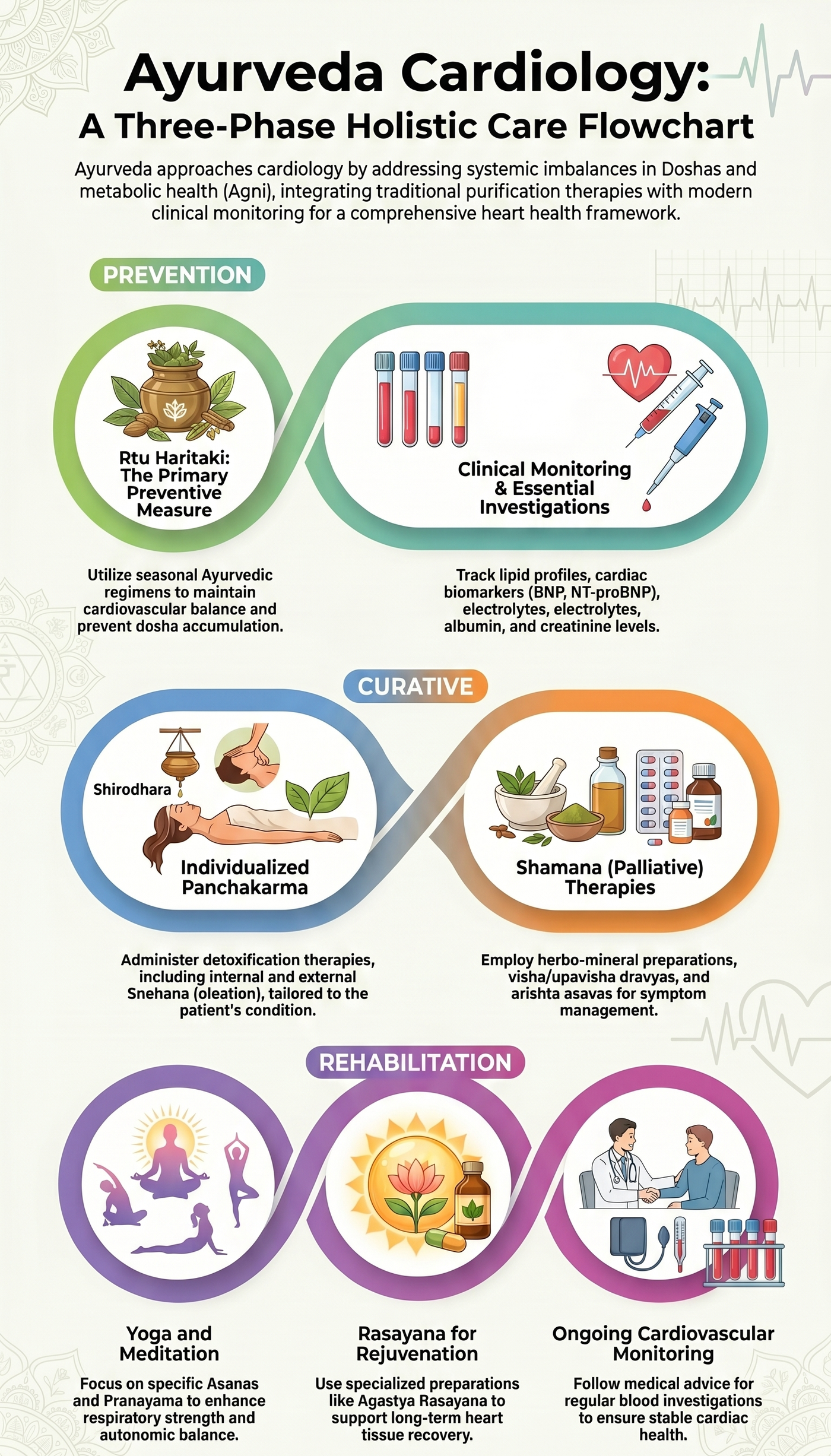
Panchakarma modalities — particularly Virechana, Basti, and Snehapana — play meaningful roles in metabolic detoxification and cardiac risk reduction. The integration of classical Dinacharya, Sattvavajaya (mind management), and targeted Rasayana protocols with evidence-based lifestyle medicine creates a genuinely integrative cardiac care model that is both clinically credible and deeply appealing to patients.
The National Institute of Ayurveda (NIA, Jaipur) now runs a dedicated Department of Ayur-Yoga Preventive Cardiology and conducts training programs in Integrative Preventive Cardiology: Combining Ayurveda, Yoga, and Modern Medicine for Heart Health — a direct validation of this field at the highest academic level. |
CAREER SCOPE & PROFESSIONAL OPPORTUNITIES
Trained Ayurvedic cardiologists are among the most sought-after BAMS specialists in today's integrative healthcare landscape. The opportunities span clinical, institutional, academic, and entrepreneurial tracks:
Clinical Practice
Integrative Cardiology OPDs: Multi-speciality hospitals and corporate health chains are establishing dedicated Ayurveda cardiology departments. A trained BAMS cardiologist functions as a primary cardiac wellness consultant, managing hypertension, dyslipidaemia, post-MI recovery, and metabolic syndrome — often in collaboration with cardiologists and internal medicine specialists.
AYUSH Hospitals & Government Sector: AYUSH wings in district and taluk hospitals are expanding under the National Health Mission. Government posts for BAMS doctors specialised in NCD management are growing, with specific demand for doctors who can manage cardiac risk factors within the public health framework.
Cardiac Rehabilitation Centres: Post-cardiac event rehabilitation is a rapidly growing subspecialty. Ayurvedic practitioners trained in cardiac care can design and deliver structured rehabilitation programmes — integrating Panchakarma, Rasayana therapy, dietary protocols, and progressive physical activity — for patients recovering from heart attacks, bypass surgery, and heart failure.
Wellness, Lifestyle & Preventive Medicine
Preventive Cardiac Wellness Clinics: India's tier-1 and tier-2 cities are seeing rapid growth in preventive health clinics targeting urban professionals at risk of cardiac events. A BAMS cardiologist can build a prevention-focused practice centred on risk stratification, Ayurvedic lifestyle prescriptions, and personalised Rasayana protocols.
Corporate Wellness Programs: Indian corporates increasingly invest in cardiac wellness for employees. Practitioners trained in Ayurveda cardiology are well-positioned to design wellness programmes, conduct health screening camps, and deliver stress and hypertension management workshops.
Telemedicine & Digital Health: Online Ayurveda consultations for chronic disease management — particularly hypertension and metabolic syndrome — have seen exponential growth. Cardiac wellness is one of the most-searched specialisations in Ayurvedic telemedicine, offering a scalable, low-infrastructure career path.
Academic & Research
Research & Clinical Trials: Ayurveda cardiology is an active area of evidence-based research. Institutions across Kerala, Rajasthan, Karnataka, and Gujarat are conducting clinical trials on Ayurvedic interventions for hypertension, IHD, and dyslipidaemia. Trained practitioners with clinical competency are in demand as research collaborators and trial coordinators.
Teaching & Faculty Roles: Ayurvedic colleges are increasingly introducing integrative cardiology content into their Kayachikitsa departments. Specialists with formal training in Ayurveda cardiology are needed as faculty, guest lecturers, and curriculum consultants.
THE INTEGRATIVE MEDICINE MOVEMENT & AYURVEDA
Globally, the integrative medicine movement — which positions evidence-informed traditional systems alongside conventional medicine — is gaining decisive institutional momentum. The WHO Traditional Medicine Strategy (extended through 2025) explicitly calls for the integration of traditional systems including Ayurveda into national health frameworks. Over 100 countries now have formal policies for traditional medicine.
In India, the Ministry of AYUSH has accelerated the integration of Ayurvedic practitioners into primary healthcare delivery, NCD management programmes, and hospital-based care. The AYUSH-NHM integration framework specifically identifies cardiology, metabolic disease, and musculoskeletal disorders as priority domains for Ayurvedic clinical engagement.
For the BAMS graduate, this institutional momentum translates directly into expanding clinical roles, government employment opportunities, and professional recognition — with cardiology being one of the most evidence-rich and professionally rewarding specialisations to pursue.
THE CERTIFICATE COURSE IN AYURVEDA CARDIOLOGY
The Certificate Course in Ayurveda Cardiology from MedMap Medical Services is a comprehensive 6-month online program that equips BAMS graduates with the knowledge and clinical competence to manage cardiac conditions using an integrated Ayurveda-contemporary medicine framework.
This course bridges the classical Ayurvedic understanding of Hridroga with modern cardiology diagnostics, pharmacology, and emergency care — preparing practitioners to deliver holistic cardiac health management in outpatient, wellness, and integrative clinical settings.
COURSE SNAPSHOT
Duration | 6 Months |
Mode | Online Training Program |
Accreditation | University Certification |
Eligibility | BAMS Graduates |
Focus Areas | Hypertension, IHD, Arrhythmias, ECG/Echo, Rasayana, Panchakarma, Emergency Care |
This article is provided by MEDMAP — a premier institution dedicated to Ayurvedic education that combines classical wisdom with contemporary clinical training. MEDMAP offers a wide range of Ayurvedic courses with hands-on clinical exposure, designed for BAMS graduates and Ayurveda practitioners at every stage of their career. 🌐 For courses, updates, and career resources, follow MEDMAP. 📱 Instagram https://www.instagram.com/ayurvedamap 🌐 Website https://medmapmedical.com |