📖 What Is Plagiarism in Research?
Plagiarism means presenting someone else's words, ideas, or data as your own — without proper attribution. In academic research, it is one of the most serious forms of misconduct, capable of ending careers, triggering retractions, and permanently damaging institutional reputations.
In Ayurveda research, plagiarism often occurs not from deliberate dishonesty but from unfamiliarity with proper citation practices, over-reliance on older theses as templates, and translating classical Sanskrit text without crediting the source edition. These are especially common pitfalls for first-time authors.
"Every journal runs a plagiarism check on your manuscript before it is peer-reviewed. If you don't run one first, you are flying blind — and one rejection for similarity can set your publication timeline back by months." |
Types of Plagiarism You Must Know
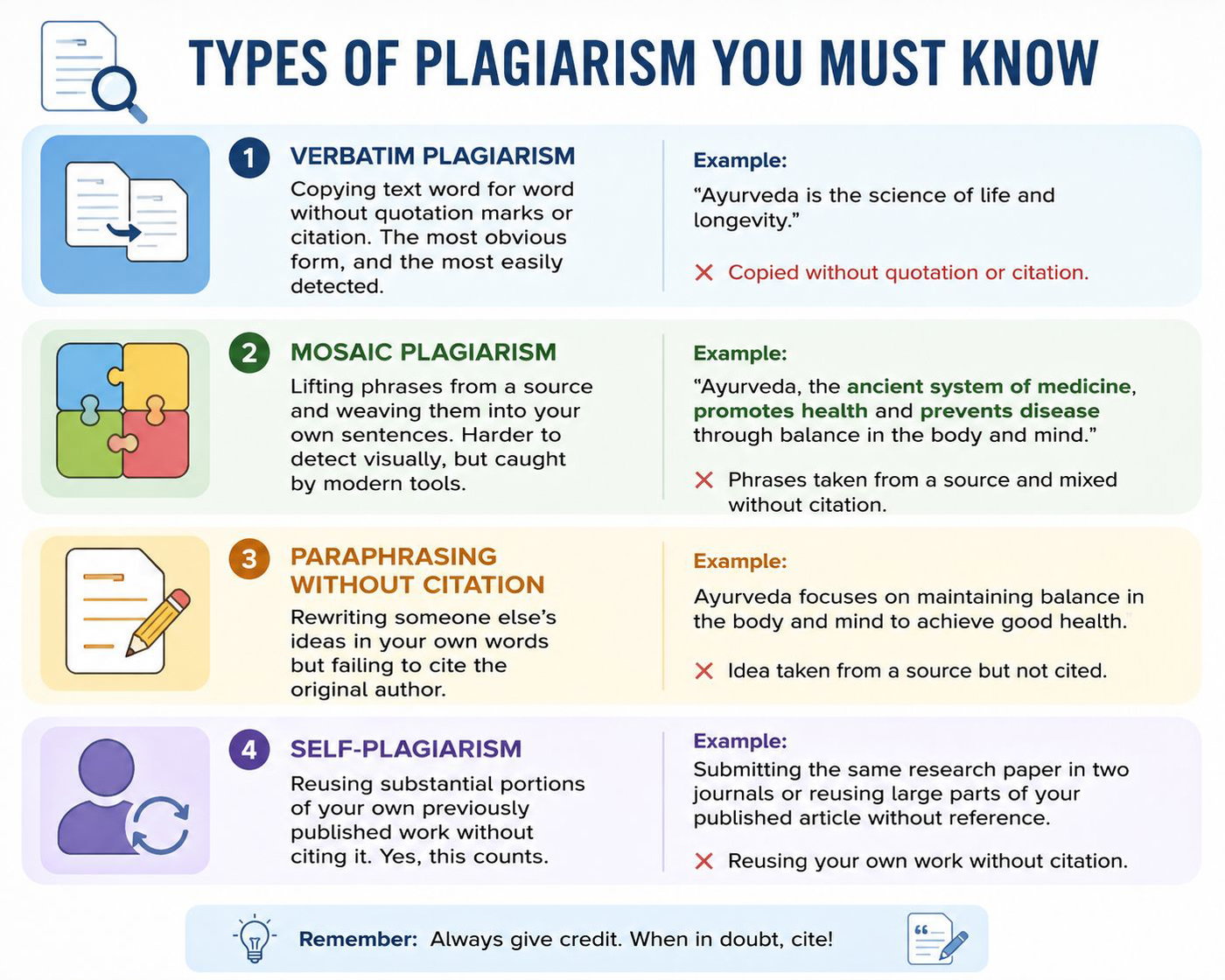
Verbatim plagiarism — copying text word for word without quotation marks or citation. The most obvious form, and the most easily detected.
Mosaic plagiarism — lifting phrases from a source and weaving them into your own sentences. Harder to detect visually, but caught by modern tools.
Paraphrasing without citation — rewriting someone else's ideas in your own words but failing to cite the original author. Still plagiarism.
Self-plagiarism — reusing substantial portions of your own previously published work without citing it. Yes, this counts. Many Ayurveda PG theses later submitted as journal articles carry excessive self-similarity.
📏 WHAT IS AN ACCEPTABLE SIMILARITY INDEX? |
⚠️ A NOTE ON SELF-PLAGIARISM |
⚙️ How Do Plagiarism Checkers Work?
Plagiarism checkers work by breaking your submitted text into short segments (called n-grams) and comparing them against a database of known content. The database is the key differentiator — a tool that checks only the public web misses all the paywalled journal articles, student theses, and institutional repositories that professional tools index.
Modern tools now also detect paraphrased plagiarism using AI-based semantic similarity algorithms — they can flag not just copied words but copied ideas expressed in different words. This is where older free tools still fall short.
🟢 Free Plagiarism Checkers
Quetext (Free Tier Available)
"Best free tool for genuine academic detection accuracy"
Pricing: Free: 1000 words/check, 5 checks/month · Paid: from $9.90/month (For full access features)
Quetext uses proprietary DeepSearch™ technology for contextual analysis, fuzzy matching, and conditional scoring. In independent testing, it correctly detected 100% of content copied directly from an academic journal.
✓ Advantages:
• 100% detection of direct copy-paste in tests
• Contextual & fuzzy matching catches paraphrasing
• Citation assistant built-in
✗ Limitations:
• Free tier restricted to 1000 words at a time
• Sometimes attributes match the wrong source
VERDICT FOR AYURVEDA RESEARCHERS: Best free-tier option for short manuscripts or draft chapters. Upgrade to paid for full manuscript checks before journal submission. Website: quetext.com |
DupliChecker (Free)
"Simple, no-limit free web checker — good for quick scans"
Pricing: Free: 1,000 words/check, unlimited daily checks · Paid: from $5/week for 10,000 words
DupliChecker has been around since 2006 and remains a widely used free tool in India. It supports PDF, Word, and Google Drive file uploads and uses colour-coded highlighting.
✓ Advantages:
• Completely free with no daily check limits
• Accepts PDF, Word, Google Drive uploads
✗ Limitations:
• Only checks against web content — not academic journals
• In tests, it detected only 5% of copied academic content
VERDICT FOR AYURVEDA RESEARCHERS: Use for quick web-content checks and blog posts only. Not reliable enough for academic manuscript submission pre-checks. Website: duplichecker.com |
Small SEO Tools (Free)
"Free, mobile-friendly, no account needed"
Pricing: Completely Free · No word limit per session
One of the most-used free plagiarism checkers in India, particularly among students and content creators. Works in a browser, requires no account, and gives instant results with source links.
✓ Advantages:
• Completely free, no account needed
• Mobile-friendly interface with instant results
✗ Limitations:
• Detected only 5% of directly copied academic text in tests
• Ad-heavy interface, no access to journal databases
VERDICT FOR AYURVEDA RESEARCHERS: Fine for checking blog posts or social media content. Not acceptable as pre-submission screening for any research journal. Website: smallseotools.com |
Grammarly (Free Tier Available)
"Grammar + plagiarism in one — but plagiarism only on Premium"
Pricing: Plagiarism check: Premium only — from $12/month · Grammar checking: Free tier available
Grammarly is primarily a grammar and writing assistant. Its plagiarism checker scans against 16+ billion web pages plus the ProQuest academic database of scholarly articles.
✓ Advantages:
• Grammar + style + plagiarism unified neatly in one ecosystem
• Works smoothly inside Word, Google Docs, and browser extensions
• Checks against the ProQuest academic database
✗ Limitations:
• The plagiarism feature strictly requires a paid plan
• Not accepted as primary check by most Indian journals
VERDICT FOR AYURVEDA RESEARCHERS: Excellent for grammar improvement and draft-stage plagiarism checks. Not a substitute for Turnitin or iThenticate before final submission to indexed journals. Website: grammarly.com |
Scribbr (Free Tier Available)
"Turnitin-powered — the most accurate tool accessible to individuals."
Pricing: Free: Generates a basic "Plagiarism Risk" score (Low/Med/High) · Paid: ~₹1,650 ($19.95) per document check.
Scribbr uses Turnitin's gold-standard detection technology and makes it available to individual researchers who cannot access Turnitin through an institution. Scans against 91 billion web pages and 69 million publications.
✓ Advantages:
• Powered by Turnitin — gold-standard accuracy
• 88% detection rate — highest available to individuals
• No institutional credentials required
✗ Limitations:
• Paid check is per-document (~₹1,650/check)
• Can become highly expensive for frequent ongoing use • Identifies only the top 5 matching sources without an exact percentage breakdown or full-text highlights.
VERDICT FOR AYURVEDA RESEARCHERS: The best option for PG scholars and researchers without institutional Turnitin access. Worth the per-document fee for a thesis chapter or final manuscript before submission to a PubMed/Scopus-indexed journal. Website: scribbr.com |
🏛️ Institutional Plagiarism Checkers
Turnitin (Institutional Access)
"The global gold standard — but only through institutions."
Pricing: Institutional subscription only — not available to individuals directly
Turnitin is trusted by over 16,000 institutions across 185 countries. Its repository contains over 1.8 billion student paper submissions in addition to standard journals and books.
✓ Advantages:
• Largest academic repository globally — 1.8 billion papers
• Free through most health universities in India — check with the library
✗ Limitations:
• Not available to individuals directly
• Submitted texts are typically added to the database by default
VERDICT FOR AYURVEDA RESEARCHERS: First, check whether your college already subscribes — most health universities provide library codes to scholars. If your institution has Turnitin, use it exclusively. Website: turnitin.com |
iThenticate (Used by Publishers / Paid)
"The gold standard for journal submissions and publishers"
Pricing: Individual: from $125/year for 5 checks · Institutional: negotiated pricing
iThenticate is the version of Turnitin designed specifically for researchers, publishers, and journals. It is used by Elsevier, Wiley, Springer, and most major medical journal publishers via Crossref.
✓ Advantages:
• Used directly by top-tier publishers and journals
• Access to proprietary scholarly databases not on the public web
✗ Limitations:
• Extremely expensive for independent individuals ($125 for 5 checks)
VERDICT FOR AYURVEDA RESEARCHERS: If your institution provides iThenticate access — use it. For individuals, Scribbr is a more affordable near-equivalent. Website: ithenticate.com |
💳 Paid Plagiarism Checkers Worth Knowing
Copyleaks (Premium / AI Focused)
"Best-in-class AI + plagiarism detection combined"
Pricing: Paid plans from ~$10.99/month for 100 pages · Free trial available
Copyleaks features advanced text-matching engines that analyze semantic meanings, cross-language entries, and code structure alongside an award-winning AI Writing Detector.
✓ Advantages:
• Industry-leading AI text generation detection
• Cross-language detection capabilities
✗ Limitations:
• Subscription model might not suit occasional writers
• Fuzzy semantic matches require careful manual parsing
VERDICT FOR AYURVEDA RESEARCHERS: Superb for academic coordinators, journal editors, or senior faculty who manage bulk student project submissions and need to screen for ghostwritten AI content. Website: copyleaks.com |
PlagScan (Pay-per-word)
"The budget-friendly academic alternative for individual scholars"
Pricing: Paid single purchases from $5.99 for ~24 pages (6,000 words)
PlagScan a sister concern of Turnitin, indexing millions of internal papers alongside web crawls. Its pay-as-you-go token model provides premium scanning without an ongoing commitment.
✓ Advantages:
• Highly customizable data privacy settings
• Affordable pay-as-you-go pricing rules
✗ Limitations:
• Database layout is smaller than Turnitin's ecosystem
VERDICT FOR AYURVEDA RESEARCHERS: An accessible alternative for single-paper validation if you want a deeper analytical report than what free software offers, but don't want the full price tag of Scribbr. Website: plagscan.com |
Unicheck (Premium Cloud)
"Sleek cloud platform optimized for heavy citation tracking."
Pricing: Paid personal plans from $15.00 for 100 pages
Unicheck stands out for its high uptime, beautifully styled layout, and interactive reporting features. It auto-detects and cleans correctly structured references or quotes (APA, Vancouver style).
✓ Advantages:
• Superb, uncluttered, interactive modern dashboard
• Extremely smart APA/Vancouver reference exclusion filters
✗ Limitations:
• Deep academic archive parsing is slightly restrictive
VERDICT FOR AYURVEDA RESEARCHERS: Great for independent researchers who need clear, pristine matching reports to attach directly to their institutional review boards. Website: unicheck.com |
📊 At-a-Glance Comparison Matrix
Scribbr | Per Document | ⭐⭐⭐⭐⭐ (Turnitin Engine) | Pre-submission Journal Screening | Individual PG Scholars & Faculty |
Quetext | Free Tier Available | ⭐⭐⭐ (DeepSearch) | Draft Check & Citation Support | Undergraduates & Early Drafts |
Turnitin | Institutional Only | ⭐⭐⭐⭐⭐ (Global standard) | University submissions | Scholars with Library Codes |
Copyleaks | Subscription | ⭐⭐⭐⭐ (AI Tracked) | AI Text Verification + Plagiarism | Editors & Reviewers |
DupliChecker | Free | ⭐ (Public Web Only) | Quick blog posts & info reading | Content Creators |
🎯 Workflow Recommendations
• The PG Scholar Writing a Thesis: Check if your health university library offers Turnitin access. If not, budget for a per-document Scribbr review before your final institutional sign-off.
• The Academic Writer on a Budget: Utilize the 500-word block limits on the Quetext free plan to iteratively review critical document zones like the Discussion or Review of Literature.
• The Peer Reviewer or Editor: Essential frameworks like Copyleaks or iThenticate are critical for verifying structural paper integrity and keeping an eye on undocumented generative AI utilization.
🌿 AYURVEDA SPECIFIC RESEARCH TIP |
This article is provided by MEDMAP — a premier institution dedicated to Ayurvedic education that combines classical wisdom with contemporary clinical training. MEDMAP offers a wide range of Ayurvedic courses with hands-on clinical exposure, designed for BAMS graduates and Ayurveda practitioners at every stage of their career. 🌐 For courses, updates, and career resources, follow MEDMAP. 📱 Instagram https://www.instagram.com/ayurvedamap 🌐 Website https://medmapmedical.com |