01 — The Intelligence Behind Digestion
In Ayurveda, Agni (Sanskrit: अग्नि, 'fire') is the totality of metabolic and digestive intelligence in the body. It governs not only the breakdown of food but also the health as a whole. The Charaka Samhita, in the context of Grahani, places it at the very centre of health:
"Ayu (life), varna (complexion), bala (strength), swastha (health), utsaha (enthusiasm), ojas (vital essence), teja (lustre), and prana (life force) — all depend on agni." — Charaka Samhita, Chikitsa Sthana 15.3 |
There are 13 types of Agni described: one Jatharagni (central digestive fire, located in the stomach and small intestine), five Bhutagnis (elemental fires processing the five mahabhutas), and seven Dhatvagnis (tissue-level fires that sequentially nourish each dhatu from rasa to shukra). Jatharagni is considered the root — when it is strong, all others function well.
02 — Agni through the modern lens
From a modern lens, Agni correlates with the ensemble of gastric acid secretion, pancreatic enzyme output, bile salt dynamics, intestinal motility, and the gut microbiome — the full apparatus by which the body digests, assimilates, and transforms food into living tissue.
Gastric acid (HCl) and pepsin initiate protein hydrolysis and govern the first gate of nutrient bioavailability. Pancreatic proteases, lipases, and amylases represent the primary enzymatic phase — their secretion is tightly entrained to meal timing and circadian rhythm, a phenomenon now well-documented in chronobiology. A 2025 integrated review in Frontiers in Microbiology synthesized evidence that the host circadian clock governs microbial composition through rhythmic feeding-fasting cycles, intestinal motility, and bile acid secretion — while microbial metabolites feed back onto core clock gene expression. Chronodisruption of this dialogue, driven largely by modern eating patterns, predisposes to metabolic syndrome, IBD, and neurodegenerative disease. (Zheng B et al., Front Microbiol. 2025;16:1712516)
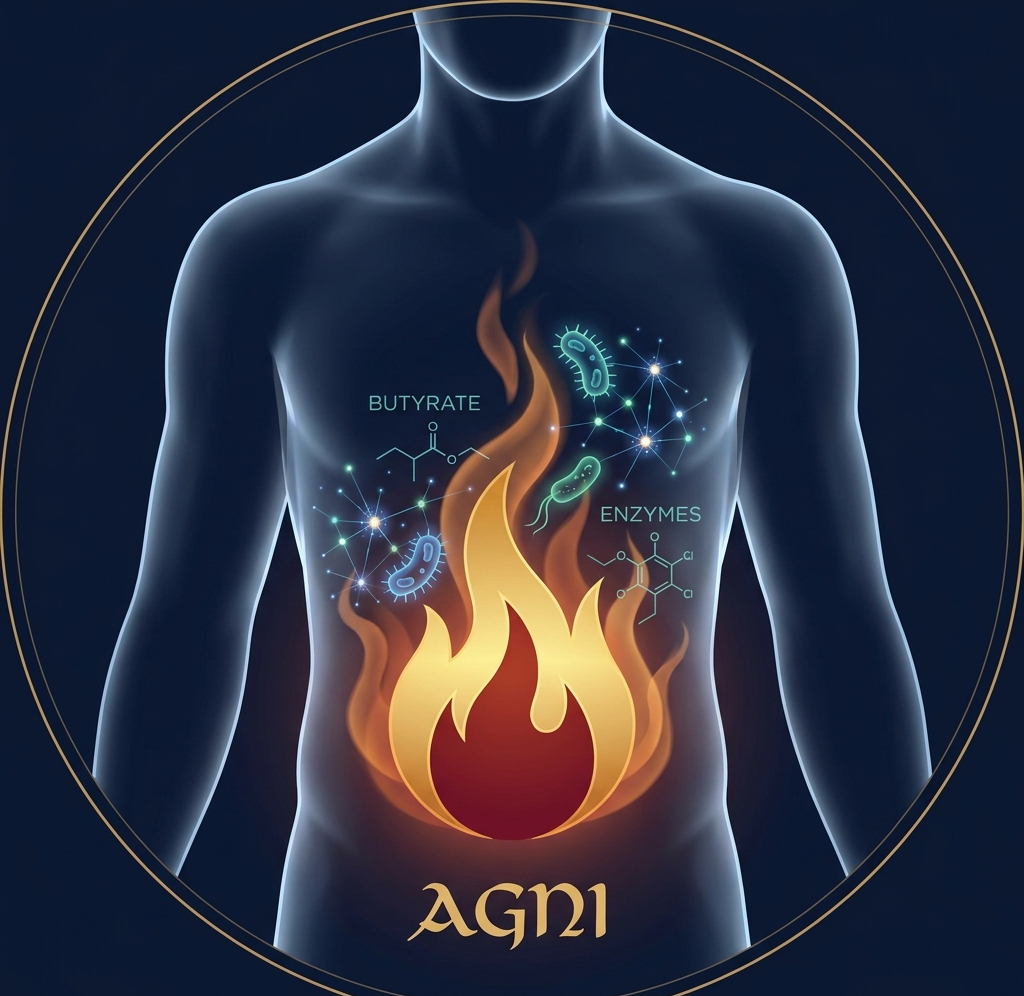
Bile salts — secreted by the liver, stored in the gallbladder, and released in response to dietary fat and protein — serve not only as emulsifiers for fat digestion but as signalling molecules that regulate gut microbial composition via the bile acid-FXR axis. Disrupted bile acid metabolism, now recognised as a driver of gut dysbiosis and metabolic disease, maps closely onto the Ayurvedic concept of impaired Pachaka Pitta — the subdivision of Pitta governing the digestive process in the small intestine.
The gut microbiome itself functions as Agni's biological extension — a 100-trillion-organism ecosystem that completes digestion, synthesizes micronutrients (B12, folate, vitamin K), produces short-chain fatty acids (SCFAs), modulates immune tone, and communicates bidirectionally with the brain via the gut-brain axis. Butyrate — produced by keystone species Roseburia intestinalis and Faecalibacterium prausnitzii — is both the primary fuel for colonocytes and the molecular anchor of intestinal barrier integrity. A landmark 2026 scoping review established that depletion of butyrate-producing bacteria 'represents a unifying pathophysiological mechanism' underlying IBD, obesity, type 2 diabetes, neurodegenerative disorders, and psychiatric conditions — a systems-level failure that Ayurveda would describe as Dhatvagni Kshaya: the sequential collapse of tissue-level metabolic fires downstream of a failed Jatharagni. (Snodgrass JL, Velayudhan BT. International Journal of Molecular Sciences, 27(3):1289, 2026. PMC12897970. DOI: 10.3390/ijms27031289)
Intestinal motility — governed by the enteric nervous system (ENS), the gut's own neural network — completes the picture. The ENS contains approximately 500 million neurons, more than the spinal cord, and operates with significant autonomy. Peristalsis, the migrating motor complex (MMC), and segmentation all require precise coordination; disruption through stress, irregular meal timing, or gut dysbiosis produces the erratic transit patterns that Ayurveda classifies as Vishama Agni. Chronic psychological stress suppresses the MMC and accelerates dysbiosis through HPA-axis-mediated cortisol release — the modern mechanism behind Charaka's clinical observation that Shoka (grief) and Bhaya (fear) directly impair digestive fire.
03 — Measuring Agni: How to Assess Its State
Ayurvedic physicians assess Agni through a combination of Nadi pariksha, tongue examination, stool analysis, and symptom inquiry. The four classical states are:
State | Description | Signs |
Sama Agni | Balanced fire | Regular digestion, clear tongue, well-formed stool, steady energy, bright eyes |
Vishama Agni | Irregular fire (Vata-type) | Variable appetite, gas, bloating, constipation alternating with loose stools, anxiety |
Tikshna Agni | Sharp/excessive fire (Pitta-type) | Intense hunger, acid reflux, heartburn, hyperacidity, inflammatory conditions |
Manda Agni | Slow/dull fire (Kapha-type) | Poor appetite, heaviness post-meal, weight gain, sluggish metabolism, excess mucus |
Ashtanga Hridayam, Sutrasthana 11 — Acharya Vagbhata's classification of agni types
When Agni is Sama — enzymes secreted on time, bile flowing freely, microbiome diverse and butyrate-rich, motility rhythmic and complete — the body transforms food into Dhatu with precision. When any one of these systems fails, the others compensate briefly before the whole network begins to degrade. This cascading failure is what classical texts called Agni Vikriti. Modern medicine calls it metabolic dysfunction, gut dysbiosis, or chronic low-grade inflammation. The biology is identical. Only the vocabulary differs.
04 — Prakriti, Age & Season
"Prakriti is one's fundamental nature, determined at conception. It governs the baseline strength, rhythm, and character of agni throughout life." Charaka Samhita, Vimana Sthana 8 |
By Prakriti:
Prakriti | Type of Agni | Features | Strength / Attributes |
Vata | Vishama Agni | Variable, easily disturbed; needs warm, grounding food and routine | |
Pitta | Tikshna Agni | Strong but prone to excess; most efficient digestion, risk of inflammation | |
Kapha | Manda Agni | Steady but slow; benefits from spices, light foods, and movement |
By Age (Trayopastambha & Trividha Bala):
In childhood (Kapha-dominant years), Agni is naturally weaker — prioritise easily digestible foods. In the middle years (Pitta phase, ~16–60), Agni is at its peak. In old age (Vata phase), it becomes irregular and needs supportive measures like warm soups, ghee, and in some cases medication.
By Season (Ritucharya):
Grishma (Summer): Agni is weakened by heat; favour light, cooling foods. Avoid heavy proteins.
Varsha (Monsoon): Agni at its lowest. Ama risk is highest. Light, digestible, sour-salty diet advised.
Sharad (Autumn): Pitta season — Agni is sharp. Cooling, bitter foods balance it. Avoid heavy meats.
Hemanta / Shishira (Winter): Coldest season — Agni is strongest. Body handles heavier, nourishing foods well.
Ashtanga Hridayam, Sutrasthana 3 — Ritucharya
05 — Vikriti of Agni: What Disturbs the Fire

When Agni becomes imbalanced, Ama is produced — undigested metabolic residue that accumulates in channels (srotas) and is considered the root cause of most disease. Key causes of Agni vikriti:
Dietary: Incompatible foods (viruddha ahara), eating before the previous meal digests, excess raw/cold foods, irregular meal times.
Lifestyle: Diurnal sleep, chronic stress, sedentary habits, suppressing natural urges (vegadharana), excessive travel.
Mental: Grief, anxiety, and anger directly impair Agni via Vata and Pitta vitiation; emotional eating disrupts timing.
Seasonal: Ritucharya violations — eating heavy food in summer or cold food in winter against seasonal doshic states.
Modern science echoes this: chronic stress downregulates stomach acid secretion and delays gastric emptying (via HPA axis dysregulation and reduced vagal tone). Circadian rhythm disruption impairs the rhythmic secretion of digestive enzymes — mice fed only during inactive phases develop metabolic syndrome regardless of calories. (Zarrinpar et al., Cell Metabolism, 2014)
06 — Kindling Agni: How to Strengthen Digestive Fire
Ayurveda prescribes a graduated approach — Deepana (kindling agni) and Pachana (digesting existing ama) before nourishing:
Approach | Method | Mechanism |
Ginger (Shunti) | Small piece with rock salt before meals | Stimulates salivary amylase; gingerols accelerate gastric emptying and increase gastric secretion (Wu et al., 2008). |
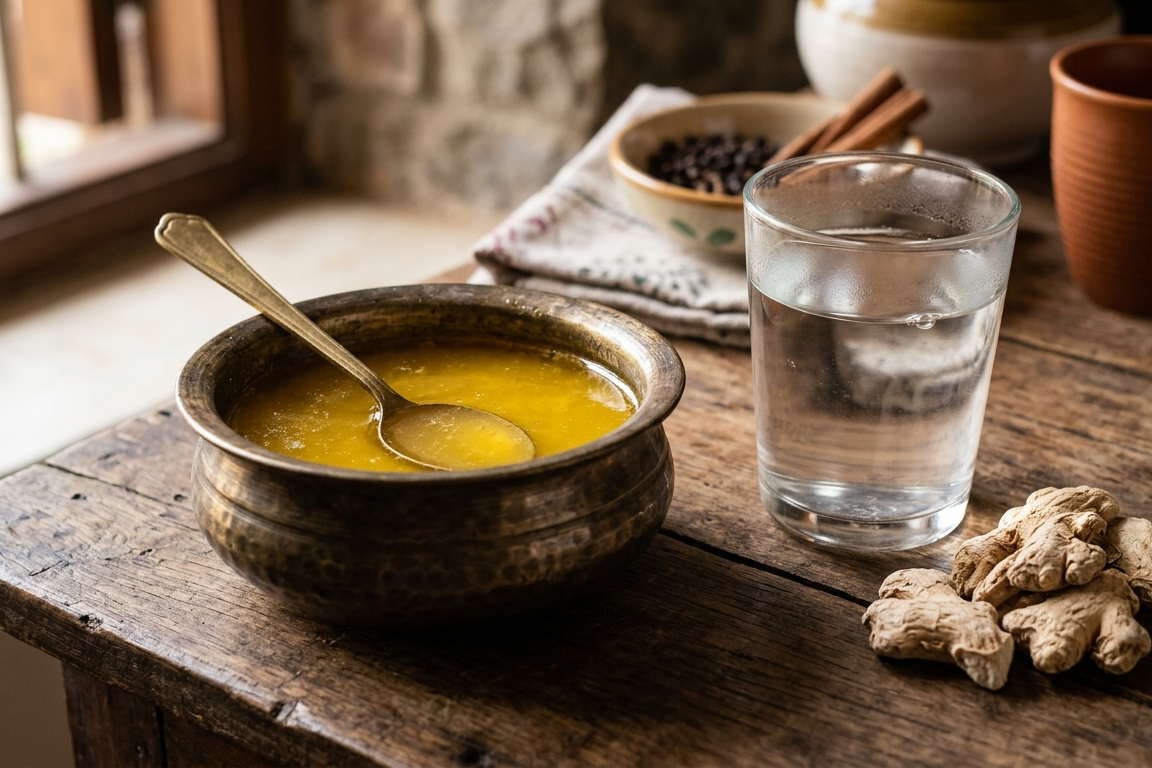
Ghee | 1 tsp with warm food | Butyrate content supports intestinal epithelium and microbiome; triggers bile secretion. |
Trikatu | Equal blend of ginger, black pepper, long pepper | Piperine enhances bioavailability; thermogenic, stimulates HCl and enzyme secretion. |
Warm Water alone or processed with Sunthi | Sip warm water through the day | Dilutes excess Kapha, maintains mucosal tone, stimulates gut motility. |
Rhythmic eating | Eat main meal at midday when sun/Pitta peaks | Aligns with peak gastric acid secretion (~12–2 pm via circadian rhythms). |
Triphala | Evening dose in warm water | Promotes peristalsis, scavenges free radicals, supports all three doshas. |
Langhana | Occasional fasting or a simple diet | Rest for digestive organs; promotes autophagy and resets mucosal immunity. |
Scientific parallel: Time-restricted eating (8–10 hr feeding windows), now widely studied, mirrors Ayurvedic meal timing principles. It improves insulin sensitivity, reduces inflammatory markers, and restores digestive enzyme rhythmicity — aligning with the concept of sama agni. | ||
07 — Protein & Agni: Why Excessive Protein Intake Burdens the Fire
This is perhaps the most practically relevant issue in modern wellness. Proteins are guru (heavy) and snigdha/ruksha depending on source — they demand the most from Agni. When intake exceeds digestive capacity, the consequences ripple through the entire system.
"Guru dravya, taken in excess of one's agni, invariably leads to the production of ama — which then obstructs the srotas and becomes the seed of disease." Charaka Samhita, Sutrasthana 26 — on heavy substances and their proper dosage |
Ayurvedic perspective: Meat and concentrated protein sources are classified as guru (heavy). The classical texts specify that only those with strong Agni (Tikshna/Sama) and who undertake physical labour can fully digest them. For Manda or Vishama Agni types — the majority — heavy protein loads produce Ama, leading to Ama-vata (a condition resembling inflammatory joint disease) and obstruction of rasa dhatu.
Scientific perspective:
Gastric burden: High protein slows gastric emptying significantly. Protein activates CCK release, reducing motility — extending digestive time and increasing dysbiosis risk.
Proteolytic overload: Exceeding the pancreas's protease output (~50–60g per meal) leaves undigested peptides in the colon, feeding putrefactive bacteria (H₂S producers).
Microbiome shift: High-protein diets reduce butyrate-producing bacteria (Roseburia, Faecalibacterium prausnitzii) and favour proteolytic species — raising intestinal permeability (Baxter et al., 2019).
mTOR & metabolic load: Chronic leucine excess from protein overfeeding chronically activates mTOR, downregulates autophagy, and has been linked to insulin resistance over time.
Agni-protein mismatch: The fitness culture norm of 1.5–2g protein/kg/day assumes sama or tikshna agni, high physical output, and young age. For Kapha or Vata prakriti individuals, the elderly, or those in Varsha/Grishma ritu, this level of intake may chronically overwhelm digestive capacity — producing ama rather than ojas. Ayurveda would advise basing protein quantity on one's actual Agni state, not a blanket gram target. |
Research now confirms a threshold effect: human and mouse studies found that protein intake beyond roughly 25g per meal (and, in male mice, beyond ~22% of daily caloric intake) activates mTOR signalling in macrophages and drives atherosclerosis — a biological validation of the classical concept of ahara matra (Zhang et al., Nature Metabolism, 2024).
The concept of ahara matra (appropriate food quantity) in Charaka Samhita (Sutrasthana 5.3) is clear: quantity is not fixed — it is determined by the digestive capacity of the individual at that moment, in that season, at that age. One size does not feed all.
Key References
Charaka Samhita — Sutrasthana Ch. 5, 26; Chikitsa Sthana Ch. 15 (Agni, Ahara Matra)
Ashtanga Hridayam — Sutrasthana Ch. 3, 11 (Ritucharya, Agni types) — Acharya Vagbhata
Wu KL et al. — Effects of ginger on gastric emptying and motility. Eur J Gastroenterol Hepatol. 2008
Zheng B, Wang L, Sun S, Yuan X, Liang Q. "The molecular interplay between the gut microbiome and circadian rhythms: an integrated review." Front Microbiol. 2025;16:1712516. doi: 10.3389/fmicb.2025.1712516
Baxter NT et al. — Dynamics of Human Gut Microbiota and Short-Chain Fatty Acids in Response to Dietary Interventions with Three Fermentable Fibers. mBio. 2019;10:e02566-18.
Wilkinson MJ et al. — Ten-Hour Time-Restricted Eating Reduces Weight, BP, and Atherogenic Lipids in Patients with Metabolic Syndrome. Cell Metab. 2020
Sonnenburg JL & Bäckhed F — Diet–microbiota interactions as moderators of human metabolism. Nature. 2016
Zhang X et al. — Identification of a leucine-mediated threshold effect governing macrophage mTOR signalling and cardiovascular risk. Nature Metabolism. 2024;6(2):359–377
Zhang X et al. — High-protein diets increase cardiovascular risk by activating macrophage mTOR to suppress mitophagy. Nature Metabolism. 2020;2(1):110–125
Ciaffi J et al. — Effects of Animal and Vegetable Proteins on Gut Microbiota in Subjects with Overweight or Obesity. Nutrients. 2023
Behounek M et al. — In Vitro Fermentation of Animal and Plant Protein Isolates by the Human Gut Microbiota Under High and Low Carbohydrate Conditions. Molecular Nutrition & Food Research. 2024
ASM Microbe 2024 — High-Protein Diet May Impact Gut Microbes and Body Composition. Adejumo et al., University of Illinois Chicago
Zhao Y et al. — Exploration of the Potential Relationship Between Gut Microbiota Remodeling Under High-Protein Diet and Crohn's Disease. Frontiers in Microbiology. 2022
Han X, Goh KY, Lee WX, Choy SM, Tang HW — The Importance of mTORC1-Autophagy Axis for Skeletal Muscle Diseases. International Journal of Molecular Sciences. 2023;24(1):297.
Yuan M, Gao K, Peng K, Bi S, Cui X, Liu Y — A Review of Nutritional Regulation of Intestinal Butyrate Synthesis: Interactions Between Dietary Polysaccharides and Proteins. Foods. 2025;14(21):3649.
Di Vincenzo F. et al. The human gut microbiota is associated with host lifestyle: a comprehensive narrative review. Frontiers in Microbiology, 2025. DOI: 10.3389/fmicb.2025.1549160
Shou J, Fu T, et al. The gut microbiome–bile acid-FXR interplay: a pivotal axis in metabolic and gastrointestinal diseases. Gut Microbes. 2026;18(1):2665890. DOI: 10.1080/19490976.2026.2665890
Snodgrass JL, Velayudhan BT. Butyrate-Producing Bacteria as a Keystone Species of the Gut Microbiome. International Journal of Molecular Sciences, 27(3):1289, January 2026. PMC12897970. DOI: 10.3390/ijms27031289
Konturek PC et al. Stress and the gut: pathophysiology, clinical consequences, diagnostic approach and treatment options. Journal of Physiology and Pharmacology, 2011;62(6):591–599. PMID: 22314561
Thaiss CA et al. Transkingdom control of microbiota diurnal oscillations promotes metabolic homeostasis. Cell, 2014;159(3):514–529 (foundational circadian-microbiome reference, still standard)
Deepthi R. et al. Adopting seasonal regimen (Ritucharya) to modulate seasonal variation in gut microbiome. Journal of Ethnic Foods, 8:8, 2021. DOI: 10.1186/s42779-021-00078-4
Disclaimer: This content is provided for educational purposes only and does not constitute medical advice. Ayurvedic and dietary recommendations discussed here, including changes to protein intake, fasting practices, or use of herbs such as ginger, Trikatu, or Triphala, should not be started, stopped, or adjusted without consulting a qualified physician or Ayurvedic practitioner, particularly for individuals with existing health conditions, on medication, pregnant, or nursing.
This article is provided by MEDMAP — a premier institution dedicated to Ayurvedic education that combines classical wisdom with contemporary clinical training. MEDMAP offers a wide range of Ayurvedic courses with hands-on clinical exposure, designed for BAMS graduates and Ayurveda practitioners at every stage of their career. 🌐 For courses, updates, and career resources, follow MEDMAP on all platforms. 📱 Instagram https://www.instagram.com/ayurvedamap 🌐 Website https://medmapmedical.com |
|---|